













▌ Зэвсэглэл · 118
Зэвсэг
- ⚔️Цахилгаан хөрөөДОМО.
- ⚾Хадаастай шийдэмХОВОР
- 🧹ШүүрЭНГ.
The central bus station near the State Department Store was the worst place to be at rush hour. Buses to every district, minivans to the ger districts, all crammed into a space designed for half the traffic. A man in a worn deel suddenly grabbed the neck of the passenger beside him and bit down. The security guard thought it was a drunk herder, fresh from the countryside, maybe fermented mare's milk, maybe vodka. He walked over casually. He did not walk back. In three minutes the screaming reached Sukhbaatar Square.
On the square, people looked at their phones. A video appeared on Facebook, Mongolia's internet living room. An old woman in front of the Mercury Market was beating a stumbling man with a frozen leg of mutton, swinging it like a club. The man fell, got up, fell again. Caption: Mongolian grandma weapon of choice. Five hundred thousand views in a country of three million. Everyone laughed. The grandmother did not see the one coming from behind.
At 6:47 PM, the Minister of Justice held a press conference at Government House on the north side of Sukhbaatar Square. An isolated incident of civil unrest, the police are handling it, citizens should remain calm. At 7:15 PM, Government House went dark. At 8:02 PM, the emergency number 102 rang unanswered. The UB Post's Twitter was still sharing an article about air pollution levels.
Ulaanbaatar is an impossible city to contain, but for the opposite reason of most cities. One and a half million people, nearly half the country's entire population, crammed into a valley between four sacred mountains. The city stretches east to west along the Tuul River, but most of the population lives in the ger districts, the vast sprawling hills of fences, felt tents, and small houses with no roads, no grid, no logic. You can block Peace Avenue, the main road, but the ger districts have a thousand dirt paths that only locals know. The cold is supposed to slow everything down. It did not slow this down.
The Narantuul Market, the Black Market, the largest outdoor market in Mongolia, was still open when it started. Shipping containers converted into shops, row after row, selling everything from horse saddles to Samsung phones. The aisles between containers were barely wide enough for two people. When people ran, they hit dead ends. Container walls on both sides, locked doors, no way out. The meat section was the worst. The smell drew them.
Peace Avenue, the main artery running east to west, became a river of abandoned cars. The traffic was already stopped, this was normal, but now the cars were empty, doors open, engines running, headlights cutting through the coal smoke haze. The State Department Store, nine floors of Soviet-era commerce, locked its doors. People pressed against the windows from inside. The glass was thick, Soviet thick. It held until someone on the sixth floor opened a window for air.
The ger districts burned. Not from the zombies but from the coal stoves tipped over in panic. The felt walls of gers catch fire fast. The wooden fences between properties channeled the flames and everything else from yard to yard. Families who had survived Mongolian winters of minus forty degrees, who knew how to endure anything the steppe could throw at them, found something they could not endure. Some rode horses out, straight north into the darkness of the steppe. The horses knew the way even if the riders no longer cared where.
Gandan Monastery, the largest functioning Buddhist monastery in Mongolia, rang its bells. The sound carried across the city in the cold air. Monks in maroon robes chanted behind wooden doors. The monastery had survived the Soviet purges of the 1930s when almost every other monastery in Mongolia was destroyed. It had survived everything. The wooden doors were old, but they were built by people who understood that doors needed to hold.
Sukhbaatar Square was empty. The statue of Chinggis Khaan sat on his throne in front of Parliament, flanked by his generals, staring south across the square. He had conquered the known world from this plateau. His bronze face showed nothing. The eternal blue sky above was hidden by coal smoke and cloud, as it was most winter evenings.
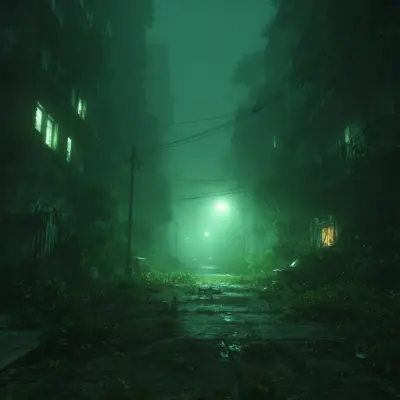
From Zaisan Memorial on the hill to the south, the bronze soldier still looked down over the city. The Soviet-era monument to friendship between Mongolia and Russia had the best view in Ulaanbaatar. Tonight the view was of a city going dark, one district at a time, the glow of ger district fires replacing electric light.
The steppe beyond the city was silent. Infinite. Dark. Empty in a way that only Mongolia can be empty. The city was small against it. Everything human was small against it.
One and a half million mouths. Open. To bite.
Nobody could say for certain where it started. Some said it was a marmot on the outskirts of the city near Zaisan Memorial, its eyes white like airag gone bad, biting a herder who had come to sell meat at the weekend market. Others swore it was a Russian-era container buried in the industrial district near the railway station, cracked open by construction workers, green liquid pooling in the frozen mud. The third rumor was the strangest: a shaman in a ger district on the northern hills was performing a ritual to contact the spirit of Chinggis Khaan, and something else answered. One thing was certain. It was Tuesday, five in the evening, and Ulaanbaatar was choking on traffic and coal smoke as always.
"Шөнө болоход Зайсан толгой хараахан гэрэлтэж байсан, амьд юм үлдээгүй хотыг алтаар бүрээд. Энхтайваны өргөн чөлөө хоосон, эргэсэн нялхсын тэрэг, орхигдсон U-Money карттай. Мөн харанхуйд, тэр өлсөж байв."
Катанагаас Билли хүүхэлдэй хүртэл. Байлдааны танкнаас цэцэрлэгийн одой хүртэл. Амьд үлдэгч бүр 3 эд зүйл авч явна: ухаалгаар сонго. Туршлага цуглуулж шинэ хэрэгсэл нээ.
Хоол урлагийн бүтээл болно. Багийн урам хэзээ ч 60%-аас буухгүй.
Хуучин ертөнцийн мэдээлэлтэй хэвээр үлдсэн багууд удаан тэсдэг. Байнгын бонус идэвхжүүлэхийн тулд нэвтэрнэ үү.
Титэм эмх замбараагүй байдалд ч хүндэтгэл шаардана. Удирдагч оршихуйг ялгаруулдаг, хэн ч тушаалд эргэлзэхгүй.
▌ 0-ЭЭС 1200+ ХҮРТЭЛ · "ЗОМБИНЫ ХООЛ"-ООС "БУРХНЫ ГОРИМ" ХҮРТЭЛ
Симуляцыг эхлүүл. Survival Score-оо олж мэд. Багаа хуваалц. Шийдвэр бүр чухал. Өдөр бүр чамайг БУРХНЫ ГОРИМ — эсвэл үхэлд ойртуулна.
▌ Баг бүрдүүлэхээс өмнө унших 4 нэвтрүүлэг