









▌ Armement · 118
Armes
- ⚔️TronçonneuseLÉG.
- ⚾Batte cloutéeRARE
- 🧹BalaiCOMMUN
The Sir Selwyn Selwyn-Clarke Market was first. Victoria's central market, a modest building of white walls and tin roofs where the entire island's commerce seemed to compress into a few hundred square meters. A fishmonger collapsed behind his stall at five nineteen. The neighboring vendor, a woman selling cinnamon and vanilla, bent to help. In the Seychelles, where everyone knew everyone, where the cashier at the bank was your cousin and the taxi driver was your uncle, nobody hesitated to help. This reflex, this small-island intimacy, was the first thing to kill.
The videos went out fast because the Seychelles had the best internet per capita in Africa, undersea cables connecting ninety-eight thousand people to the world with the bandwidth of a European city. A tourist at the clock tower filmed twenty seconds of people running down Francis Rachel Street. A Creole fisherman livestreamed from his boat in the harbour, commentary in Kreol Seselwa, describing what he saw on the waterfront with the calm of a man used to reading the sea. Cable and Wireless held until six oh two. Airtel until six oh five. Then the two cell towers serving Victoria both went down, not from overload but because the power grid serving the east coast tripped, and the backup generator at the telecom station had not been serviced since the previous cyclone season.
The President spoke from State House at six forty-seven. In a country of ninety-eight thousand, the President knew most of the people he was addressing. His voice broke once. He activated the Seychelles People's Defence Forces. The SPDF numbered three hundred soldiers for the entire archipelago. Three hundred soldiers, two patrol boats, and no air force. The police numbered five hundred. In a country where the most serious crime was typically poaching or drug smuggling, eight hundred armed personnel seemed like an army. Tonight, it was not enough for a single street.
Victoria was a capital city that fit inside a few blocks. The clock tower, modeled after London's Little Ben, marked the centre. The market, the courthouse, the cathedral, the Hindu temple, the mosque, all within walking distance. This compactness, this charm, became a death sentence. There was no distance between anything. The dead at the market were three minutes' walk from the hospital, four minutes from the school, five minutes from the port where the ferry to Praslin was loading its last passengers.
The houses of Victoria climbed the granite hillsides in layers of colour, blue, green, yellow, pink, the tropical palette of a people who saw beauty as a necessity. The roads between these houses were single-lane, steep, flanked by granite boulders and tropical vegetation so dense that two people could not walk side by side. These roads became corridors where escape was possible only in one direction, and if that direction was blocked, there was only the jungle. The jungle of the Seychelles, ancient and dense, the last remnant of Gondwana, closed behind anyone who entered and did not give them back.
The cathedral of the Immaculate Conception, the small white church on Oliver Maradan Street, opened its doors. Three hundred people filled a space meant for one hundred and fifty. The Hindu temple on Quincy Street opened its carved doors. The mosque on Francis Rachel Street called the faithful. In the Seychelles, where Christians, Hindus, and Muslims lived on the same streets and attended each other's celebrations, every sanctuary filled with everyone.
Beau Vallon, the tourist beach on the other side of the mountain from Victoria, learned what was happening when the first cars came over the Sans Souci pass at speed. The hotels, the Hilton, the Savoy, the Coral Strand, locked their lobbies. Tourists who had come for the bluest water in the Indian Ocean found themselves barricaded in five-star rooms listening to sounds that no travel brochure had mentioned.
At eleven that night, Mahe Island was visible from the air as a dark shape in a silver ocean, the power grid having failed completely at nine thirty-one. The lighthouse on the northern point still flashed, solar-powered, marking a coast that no ship would approach. Praslin and La Digue, the other inhabited islands, could see the glow of fires on Mahe across the dark channel. The ferry had not arrived. The phone lines were dead. The smaller islands waited.
Victoria. The smallest capital in Africa. The city where the entire phone book was a pamphlet and where the president walked to work. The city of coco de mer and giant tortoises and water so clear you could see your shadow on the sand twenty feet below. Ninety-eight thousand mouths. Across all the islands. Open. To bite.
Nobody could say for certain where it started. Some blamed the cargo vessel from Mombasa that had docked at Victoria's inter-island quay with a crew of eleven and departed with a crew of seven, the missing four listed as medical evacuations that never reached the hospital. Others pointed to the fish market at Sir Selwyn Selwyn-Clarke, where a fisherman from Praslin had unloaded a catch that included something pulled from the deep water off the Amirantes Plateau, a thing with too many limbs and a smell that cleared the market for twenty minutes before commerce won over caution. A few whispered about the coconut plantation behind Sans Souci, where workers had found an unmarked grave that wasn't old and wasn't quite still. It was a Tuesday. Five eighteen in the afternoon. The hour when the traffic on the only road between Victoria and Beau Vallon backed up behind the mountain pass at Sans Souci, when the market vendors were packing the last of the day's fish and fruit, when the Seychellois capital, the smallest capital in Africa, began its gentle transition from work to evening.
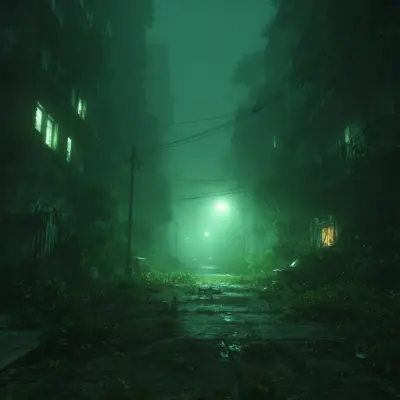
« À la tombée de la nuit, la Clock Tower brillait encore au-dessus d'Independence Avenue, éclairant une ville où plus rien de vivant ne restait. La Palm Street, déserte, était jonchée de taxis renversés et de sarongs abandonnés. Et dans l'obscurité, elle avait faim. »
Du katana à la marionnette de Billy. Du char de combat au nain de jardin. Chaque survivant a droit à 3 items : choisis-les bien. Débloque de nouveaux objets en gagnant de l'expérience.
Les repas deviennent des œuvres d'art. Le moral de l'équipe ne descend jamais sous 60%.
Les équipes qui disposent encore de quelques informations sur le monde d'avant tiennent plus longtemps. Connecte-toi pour activer le bonus permanent.
La couronne impose le respect même au milieu du chaos. Le leader rayonne de prestance, personne ne conteste ses ordres.
▌ DE 0 À 1200+ · DE "NOURRITURE À ZOMBIES" AU "MODE DIEU"
Lance la simulation. Découvre ton Survival Score. Partage ton équipe. Chaque décision compte. Chaque jour te rapproche du MODE DIEU, ou de la mort.
▌ 5 transmissions à lire avant de constituer ton équipe